Google Enters Stablecoin Payment Infrastructure Wars with GCUL
Can Google Build the Payment Blockchain Infrastructure Banks Trust?


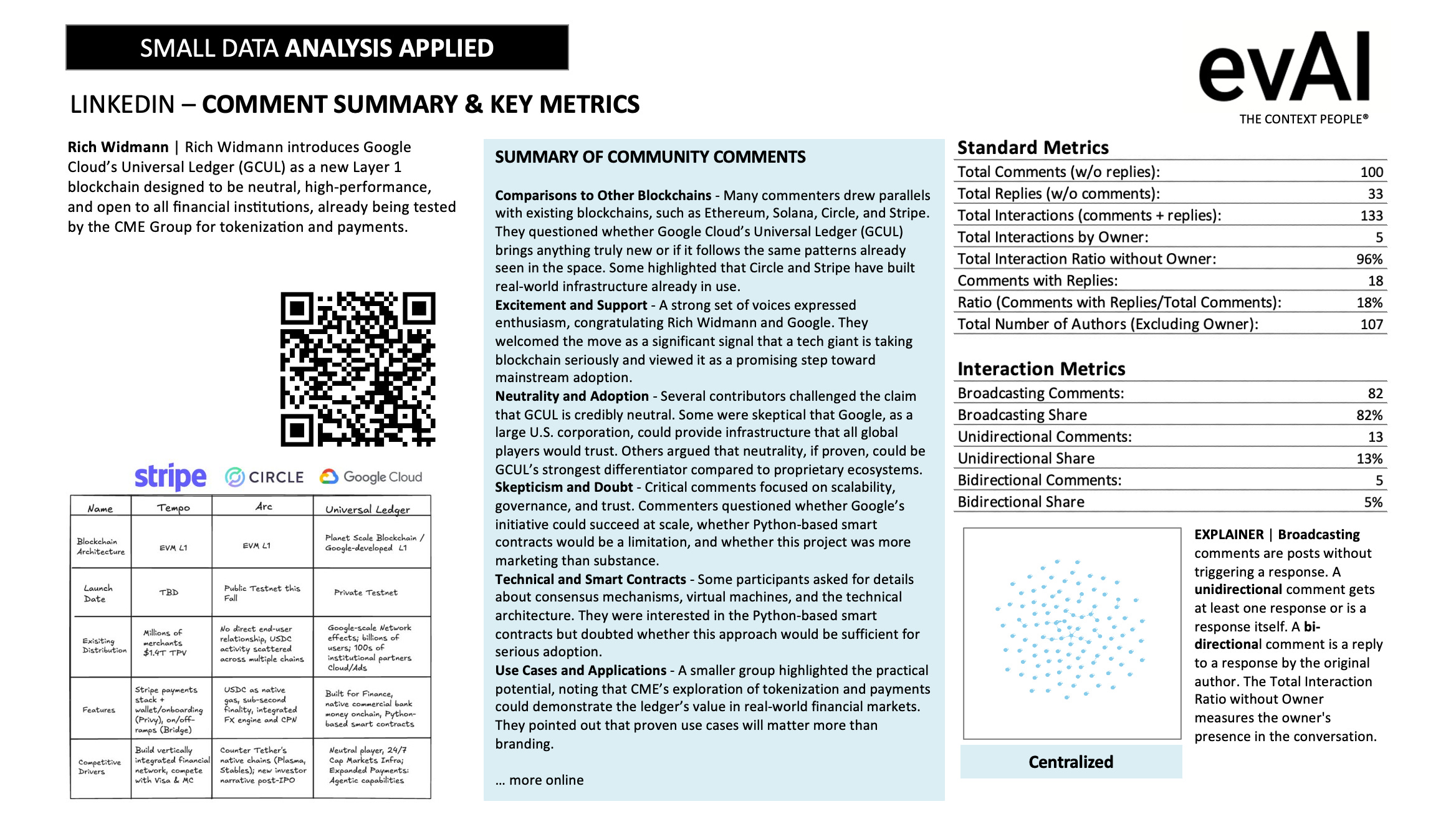
For today’s article, we had a closer look at the kick-off post of Google Cloud’s Universal Ledger (GCUL) launch by Google’s head of Web3 strategy and cloud, and listened to the first market comments that followed. It was revealing to gain early insights into trust, credibility, competition, and the race for institutional adoption of next-generation payment rails.
Last week, Rich Widmann, head of Web3 strategy at Google, introduced the Google Cloud’s Universal Ledger (GCUL) as a new Layer 1 blockchain designed to be neutral, high-performance, and open to all financial institutions, already being tested by the CME Group for tokenization and payments.
His post on LinkedIn provoked a debate, which we analyzed with our Semantic Intelligence framework. The competition at the same time continues to heat up, with Fireblocks also announcing an actual product launch the same week: Fireblocks Launches Network for Global Stablecoin Payments to power stablecoin payments across more than 100 countries, including Singapore and Hong Kong.
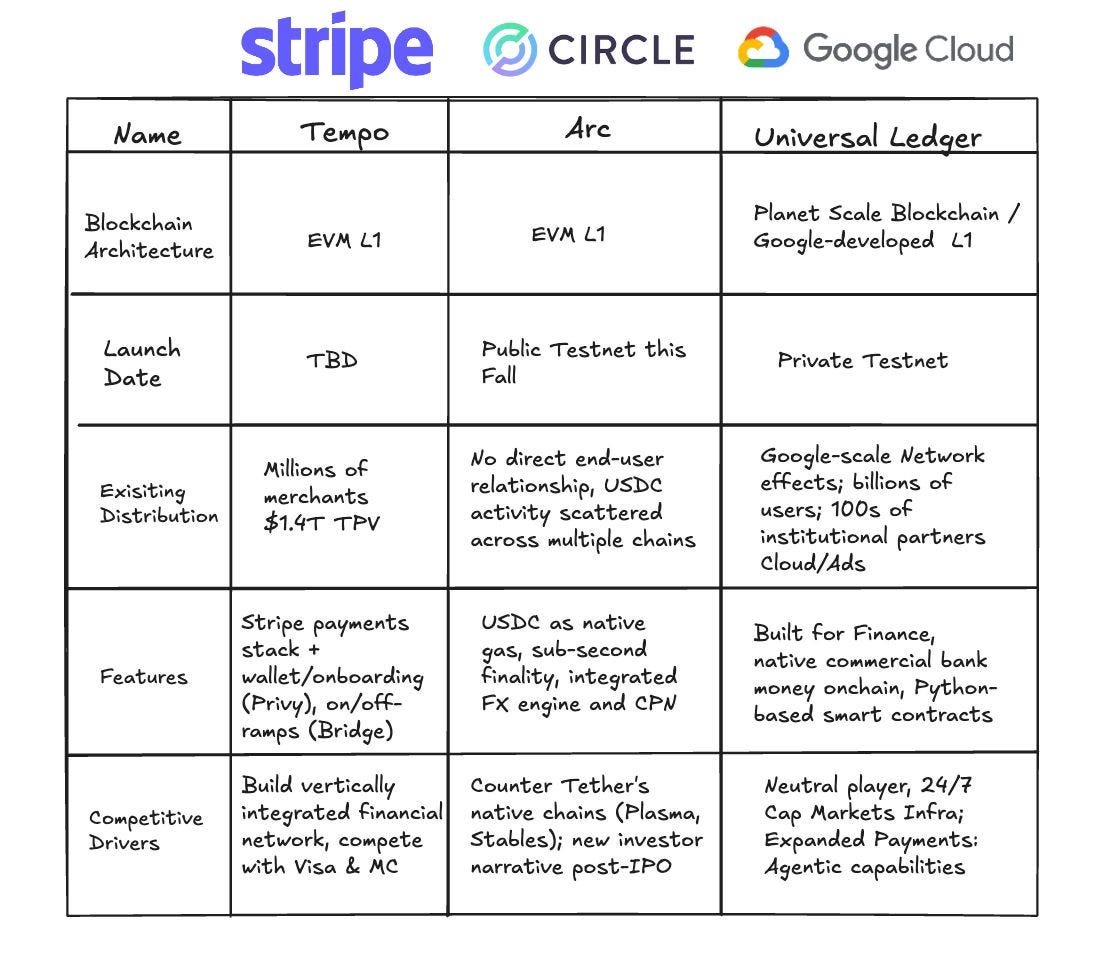
Rich Widmann's confident hypothesis is:
Google Cloud’s Universal Ledger (GCUL) can serve as a neutral, high-performance Layer 1 blockchain that any financial institution can adopt, overcoming the competitive limitations of proprietary blockchains like those from Stripe or Circle.
The thought leadership Google post on Stablecoins Beyond stablecoins: The evolution of digital money positions GCUL as the tech needed to re-imagine the infrastructure for money movement (not reimagining money itself). Google says that commercial bank money and robust traditional finance regulation help solve for stability, regulatory clarity, and capital efficiency in the existing financial system. Google Cloud provides the necessary infrastructure upgrade. `
Behind the Curtain – When the Audience Speaks
Community Debate Insights
When Rich Widmann introduced Google Cloud’s Universal Ledger (GCUL) on LinkedIn, he framed it as a new kind of Layer 1 blockchain. One that isn’t limited by the loyalties of Fintechs like Stripe or Circle (or Fireblocks for that matter). One that any institution, regardless of alignment or agenda, could use to build and innovate. The claim: GCUL is neutral, performant, and Python-friendly, a credible foundation for the next era of financial infrastructure, according to Widmann.
The audience responded in force. Over 100 voices joined the thread, many of them industry insiders. While congratulations poured in from some corners, others began pulling at the threads. What does neutrality mean when the provider is Google? Can a Python-based contract layer really scale? And crucially, is GCUL a reinvention, or just another name on a growing list of Layer 1s or Layer 2s that claim to fix the same old problems?
One of the most prominent themes in the comments was comparison. Ethereum, Solana, Circle, Stripe: if GCUL is the answer, what was the question? Many responses pointed out that Google is arriving late and does not appear to be significantly different from its competitors. Others, more optimistic, saw GCUL as proof that institutional-grade Tech players are finally stepping in, and that credibility, scale, and distribution could shift what counts as innovation.
Notably, neutrality emerged as a double-edged word. For some, it was precisely what the market needed: an infrastructure layer free from platform wars. For others, the idea that a U.S. tech giant could deliver neutrality — in a global financial context — felt naive.
Technical concerns also surfaced, though less emotionally. Developers and product thinkers asked about consensus, governance, and how real the eventual open-source ambitions were. A few noted that, until use cases like CME’s pilot move into production, GCUL remains more promising than a platform.
The post became more than an announcement. It turned into a rough, unfiltered test case of product-market signal. In the range of reactions — from enthusiasm to skepticism — the conversation painted a clearer picture than any press release could.
Community Wisdom – Takeaways
For Product Teams at Google Cloud - Make the neutrality claim operational, not rhetorical. Show how governance, access, and incentives are structured to support truly broad institutional participation. Right now, “credibly neutral” reads more like a slogan than a spec.
For Financial Institutions - The audience is watching who builds first. CME’s exploration is promising, but execution will speak louder than alignment. Early movers who go beyond POCs will shape how GCUL is perceived.
For Competing Infrastructure Providers - Google’s presence validates the market, but it also brings pressure. The conversation showed that “credibility” now includes governance transparency, global accessibility, and resilience against vendor lock-in.
For the Broader Tech and Crypto Community - This was a reminder that infrastructure is not just about code. It’s about who controls it, who uses it, and what people believe it stands for. Trust, as always, is the real consensus mechanism.
For Blockchain Developers and Architects - There is interest in Python contracts, but not yet confidence. Share benchmarks, tooling paths, and practical demos that show this isn’t just a developer onboarding trick — it’s a robust choice for scalable architecture.